

Sales and marketing alignment: A 7-step B2B framework

Sales and marketing alignment is the operating discipline that keeps both teams focused on the same revenue outcomes, target accounts, buying groups, signals, messages, and next actions. It replaces a one-way lead handoff with a shared system for identifying demand, coordinating engagement, and improving pipeline performance.
In complex B2B purchases, several people may research, influence, approve, and use a solution. A single lead rarely represents the full opportunity. Aligned teams combine account and buyer context so everyone understands where demand is forming, what the buying group needs, and who should act next.
This guide provides a seven-step framework for building that operating system.
In this guide:
- What sales and marketing alignment means
- What strong alignment looks like
- Why alignment matters
- Signs your teams are misaligned
- Seven sales and marketing alignment best practices
- Metrics for measuring alignment
- Tools that support alignment
- A practical B2B example
- Frequently asked questions
What is sales and marketing alignment?
Sales and marketing alignment is a shared go-to-market operating model in which both teams agree on whom to target, how demand is recognized, how accounts and buyers progress, what actions each team takes, and how performance is measured.
Alignment does not mean that sales and marketing perform the same work. Marketing still creates and captures demand, builds audiences, runs programs, and shapes the buyer experience. Sales still develops relationships, discovers needs, manages opportunities, and closes business. Alignment means those responsibilities operate inside one connected system.
Aligned teams share:
- Revenue goals: Both teams understand the pipeline and revenue outcomes they are responsible for producing together.
- An ideal customer profile: Both teams use the same criteria to determine which companies fit the market.
- Target accounts and buying groups: Both teams know which accounts matter, which people influence the purchase, and where coverage is missing.
- Journey stages: Both teams use the same definitions for engagement, qualification, opportunity progression, and expansion.
- Signals and data: Both teams can see the account activity, buyer behavior, intent, and opportunity context needed to act.
- Plays and next actions: Both teams know what should happen when a meaningful signal appears.
- Performance measures: Both teams review the same conversion, velocity, pipeline, and revenue metrics.
What does strong sales and marketing alignment look like?
The standard for alignment is not whether sales and marketing attend the same meeting. The standard is whether both teams can recognize the same opportunity, agree on its priority, coordinate the right actions, and learn from the outcome.
Level 1: Shared visibility
Sales and marketing use a common account view, shared definitions, and consistent performance data. Each team can see what the other team sees, but actions may still happen independently.
Level 2: Coordinated action
Meaningful buyer and account signals trigger clear notifications, ownership, and next steps. Marketing and sales coordinate outreach, content, and timing instead of relying on an informal handoff.
Level 3: Orchestrated plays
Sales, marketing, sales development, and revenue operations run repeatable plays across the account journey. The teams use the same data, make decisions together, and adapt based on conversion and revenue results.
Related → See the three levels of sales and marketing alignment maturity
Why sales and marketing alignment matters
Alignment matters because buyers experience one company, not separate departments. When the teams operate from different account lists, definitions, messages, and data, the buyer experiences the gaps.
Strong alignment improves the revenue process in several ways:
- Better prioritization: Teams concentrate time and budget on accounts that fit the business and show meaningful readiness.
- More complete buyer coverage: Marketing and sales work together to identify, engage, and educate the full buying group instead of relying on one contact.
- Faster action on demand: High-value signals reach the right owner with enough context to take a useful next step.
- More consistent messaging: Campaigns, website experiences, seller outreach, and executive conversations reinforce the same value story.
- Stronger conversion: Shared qualification and stage criteria make it easier to identify where accounts advance, stall, or fall out of the process.
- Clearer accountability: Teams diagnose problems using shared data instead of debating whose dashboard is correct.
- More reliable planning: Common pipeline assumptions and conversion metrics improve forecasting and resource allocation.
Signs your sales and marketing teams are misaligned
Misalignment usually appears in day-to-day execution before it appears in a quarterly revenue report. Watch for these signals:
- Sales and marketing use different definitions of a qualified lead, account, opportunity, or buying stage.
- Sales says lead quality is poor while marketing reports that lead targets are being met.
- The teams prioritize different accounts or cannot explain why an account is on the target list.
- Marketing cannot see whether sales acted on an account, and sales cannot see the marketing activity that preceded outreach.
- High-intent or high-engagement accounts wait too long for follow-up because ownership is unclear.
- Sales creates one-off content because existing marketing assets are difficult to find or do not match live buyer objections.
- Campaign messaging and sales conversations describe the product, problem, or value differently.
- Meetings focus on activity updates rather than account decisions, conversion problems, and next actions.
- Each team reports pipeline and revenue using different attribution logic or stage definitions.
- Closed-lost insights do not change targeting, messaging, content, or qualification criteria.
Pro Tip → Diagnose alignment at the operating level. Ask whether both teams agree on the same account, buying group, stage, signal, owner, next action, and success measure. A disagreement in any one of those areas reveals the process that needs to be fixed.
How to align sales and marketing: seven best practices
Use the following seven-step framework to turn alignment from a general goal into a repeatable operating system.
1. Build one revenue and pipeline model
Objective:
Translate the company revenue target into one shared model for the pipeline, conversion, and account coverage required to reach it.
Start with the business outcome, then work backward. Sales, marketing, finance, and revenue operations should agree on the assumptions that connect market activity to revenue.
The model should define:
- Revenue targets: Net-new, expansion, segment, region, and product goals.
- Pipeline requirements: The qualified pipeline needed to support those goals.
- Conversion assumptions: Expected movement between qualified account, opportunity, and closed-won stages.
- Velocity assumptions: The expected time accounts spend in each stage.
- Capacity constraints: The number of accounts sales and marketing can engage effectively by segment and motion.
- Shared leading indicators: Account engagement, buying-group coverage, sales action, and stage progression.
Do not give marketing an isolated lead-volume target and sales an isolated revenue target. Connect both teams to the same pipeline model so they can see how targeting, engagement, sales action, conversion, and revenue affect one another.
Required output:
A shared revenue and pipeline model with named owners, documented assumptions, one dashboard, and a scheduled review cadence.
2. Agree on the ICP, target accounts, and buying groups
Objective:
Make sure both teams pursue the same market and recognize the same people involved in each purchase.
Define the ideal customer profile at the company level. Include the firmographic, technographic, operational, and strategic characteristics that indicate fit. Then separate fit from readiness: an account can match the ICP without being ready to buy, and an active account can show interest without being a strong long-term fit.
Build a target account system that includes:
- Fit criteria: Industry, company size, geography, technology environment, use case, and business characteristics.
- Exclusion criteria: Conditions that make an account unserviceable, unprofitable, or unlikely to succeed.
- Account tiers: The level of investment and personalization each account warrants.
- Readiness signals: Intent, engagement, timing, opportunity context, and relevant business changes.
- Buying-group roles: Champions, decision-makers, technical evaluators, financial approvers, users, procurement, and potential blockers.
- Coverage requirements: The roles that must be known or engaged before the account advances.
Pro Tip → Separate fit from readiness. Fit tells you whether an account belongs in your market. Intent, engagement, and opportunity context tell you whether the account deserves action now.
Required output:
A governed target account list, tiering model, buying-group map, and documented criteria for adding, removing, and reprioritizing accounts.
Related → See how Demandbase helps teams identify and engage complete buying groups
3. Define one account journey and shared stage criteria
Objective:
Give sales and marketing one language for describing where an account is, what must happen next, and who owns that action.
Replace vague labels with observable criteria. A stage should describe the state of the account or buying group, not simply which team currently owns it.
A practical account journey can include:
- Target: The account meets ICP and prioritization criteria.
- Aware: The account has received or encountered relevant brand and category messaging.
- Engaged: One or more people at the account show meaningful first-party or third-party activity.
- Qualified account: Fit, readiness, buying-group evidence, and agreed engagement criteria justify coordinated action.
- Opportunity: Sales has confirmed a business problem, active evaluation, and a credible path to a purchase decision.
- Customer: The account has purchased and entered adoption, value realization, and retention motions.
- Expansion: New needs, stakeholders, products, or business units create an additional revenue opportunity.
For every stage, document the entrance criteria, exit criteria, required data, accountable owner, expected actions, and time threshold. Use the same definitions in the CRM, marketing automation platform, dashboards, and operating reviews.
Required output:
A one-page lifecycle document that defines every stage and the evidence required for progression, recycling, or disqualification.
4. Create handoff and action SLAs
Objective:
Turn important signals into timely, accountable action without relying on informal messages or manual follow-up.
A sales and marketing service-level agreement should define more than when marketing passes something to sales. It should govern the actions both teams take throughout the account journey.
Each SLA must specify:
- Trigger: The event or combination of events that requires action.
- Qualification: The fit, readiness, buying-group, and data requirements that must be present.
- Owner: The person or team responsible for the next action.
- Response time: The maximum time allowed before the action begins.
- Required action: The outreach, campaign, research, routing, or account update that must occur.
- Feedback: The status and reason code the owner must return.
- Recycling rule: What happens when the account is not ready, the signal is weak, or the contact is wrong.
Starting SLA standard:
- High-intent target account: Review and begin the agreed action during the same business day.
- Qualified account: Accept, reject, or request more context within one business day.
- Rejected or recycled account: Record a standardized reason within two business days.
- Stalled opportunity: Review the buying group, recent engagement, objections, and next-best play during the weekly account standup.
Required output:
An SLA matrix embedded in the workflow system, with automated routing, reminders, status tracking, and reason codes.
5. Create one shared account and buying-group view
Objective:
Give every revenue team member the account context required to make the same prioritization decision.
The shared view should bring together the information sales and marketing need without forcing either team to reconstruct the account story across disconnected tools.
Include:
- Account identity and hierarchy: Parent, subsidiary, business unit, territory, and ownership.
- ICP and tier: Fit score, segment, priority, and the reason the account was selected.
- Buying-group coverage: Known people, roles, engagement, influence, and missing stakeholders.
- First-party engagement: Website activity, content, events, forms, email, product interaction, and campaign response.
- Third-party intent: Relevant research topics and changes in research intensity.
- Sales activity: Outreach, meetings, notes, objections, tasks, and relationship history.
- Opportunity context: Stage, amount, use case, competitors, next step, risks, and timing.
- Recommended action: The next play, owner, timing, and supporting content.
Revenue operations should own the field definitions, system of record, data quality rules, account matching, and synchronization requirements. Sales and marketing should own how the information is used.
Pro Tip → A shared dashboard is not enough if the underlying definitions differ. Document the source of truth for every critical field and remove duplicate versions of account stage, engagement, qualification, and pipeline.
Related → Explore account intelligence for a shared view of accounts, buyers, and signals
6. Coordinate messaging, content, and next-best actions
Objective:
Make every buyer-facing interaction feel like part of one coherent conversation.
Create a shared message map for each priority use case and buying-group role. The map should define:
- Business problem: The operational or strategic issue the buyer needs to solve.
- Value hypothesis: The outcome the account can reasonably expect.
- Role-specific relevance: Why the issue matters to each buying-group member.
- Proof: Customer evidence, product capability, implementation detail, and risk reduction.
- Objections: The questions or concerns likely to delay the decision.
- Next action: The most useful step for the buyer at that moment.
Turn the message map into integrated plays for recurring account conditions:
- A high-fit account begins researching the category.
- A target account engages heavily but has no open opportunity.
- An opportunity has a champion but lacks an economic buyer or technical evaluator.
- A buying group is active, but sales outreach has not received a response.
- An opportunity stalls after a competitor, security, procurement, or budget objection.
- An existing customer shows new intent related to expansion.
For each play, define the audience, trigger, message, channel, content, owner, sequence, exit condition, and measurement. Marketing should use sales feedback to improve the play, while sales should use the approved message and content rather than recreating the buyer story from scratch.
Required output:
A shared playbook organized by account condition, buying-group role, journey stage, and next-best action.
Related → Learn how orchestration coordinates sales and marketing actions across the account journey
7. Run one operating cadence and improve the system
Objective:
Create a decision rhythm that keeps teams aligned as accounts, markets, and performance change.
Use three connected cadences:
- Weekly account action standup: Review newly active accounts, buying-group gaps, unaccepted alerts, stalled opportunities, SLA exceptions, and the next plays to run.
- Monthly performance review: Review conversion, sales action, response time, pipeline velocity, account coverage, win-loss patterns, and play performance by segment.
- Quarterly strategy review: Revisit the ICP, target account capacity, tiering, pipeline assumptions, buying-group model, messaging, channel mix, and resource allocation.
Send status data before the meeting. Use live meeting time for decisions, exceptions, and commitments. Record the owner and due date for every decision, then review completion at the next cadence.
Pro Tip → Cancel recurring meetings that only restate dashboard activity. An alignment meeting should end with a changed priority, a coordinated account action, a resolved process issue, or a documented decision.
Required output:
A shared calendar, standard agenda, decision log, and action tracker connected to the revenue workflow.
Sales and marketing alignment metrics
Measure alignment with metrics that show whether the teams are targeting the right accounts, acting on demand, progressing buying groups, and producing revenue together.
| Metric | What it measures | Review cadence |
|---|---|---|
| Target-account coverage | The percentage of priority accounts with valid ownership, fit, tier, and required account data. | Monthly |
| Buying-group coverage | The percentage of required buying roles identified and engaged within active accounts. | Weekly and monthly |
| Engaged-to-qualified account conversion | How often meaningful engagement becomes a qualified account that warrants coordinated action. | Monthly |
| Sales action rate | The percentage of qualified accounts or high-value alerts that receive the required sales action. | Weekly |
| Median response time | How long it takes the assigned owner to act after an agreed trigger occurs. | Weekly |
| Qualified-account-to-opportunity conversion | How often qualified accounts become confirmed sales opportunities. | Monthly |
| Stage conversion | Where accounts advance, stall, recycle, or leave the journey. | Monthly |
| Pipeline velocity | How quickly qualified pipeline moves through the opportunity stages. | Monthly |
| Win rate and revenue | Whether aligned motions produce closed-won business in the intended segments and account tiers. | Monthly and quarterly |
Segment every metric by account tier, market, use case, source, and play. A blended average can hide a strong motion in one segment and a broken process in another.
Related → See how account-based analytics connects engagement, pipeline, and revenue performance
What tools support sales and marketing alignment?
The right sales and marketing alignment tools create shared context, automate agreed workflows, and measure account progression. Technology should reinforce the operating model rather than substitute for it.
A complete alignment stack usually includes:
- Customer relationship management: Account ownership, opportunities, activities, stages, and forecast data.
- Marketing automation: Campaign execution, nurture, forms, email engagement, and lifecycle workflows.
- Account and buying-group intelligence: Fit, identity, contact roles, account research, and prioritization.
- Intent and engagement data: Evidence that accounts and buyers are researching, interacting, or becoming more active.
- Orchestration and workflow automation: Routing, alerts, next-best actions, coordinated plays, and task completion.
- Analytics and reporting: Shared measurement of engagement, conversion, pipeline, velocity, and revenue.
- Content and sales enablement: Governed messaging, buyer-ready assets, playbooks, and usage feedback.
- Data management and integrations: Account matching, enrichment, deduplication, governance, and synchronization across the stack.
Evaluate tools against the operating questions that matter: Can both teams see the same account and buying group? Can the system explain why an account is prioritized? Can a signal trigger an accountable action? Can the teams measure whether that action changed pipeline?
Related → Hear Demandbase sales and marketing leaders explain how they align teams in practice
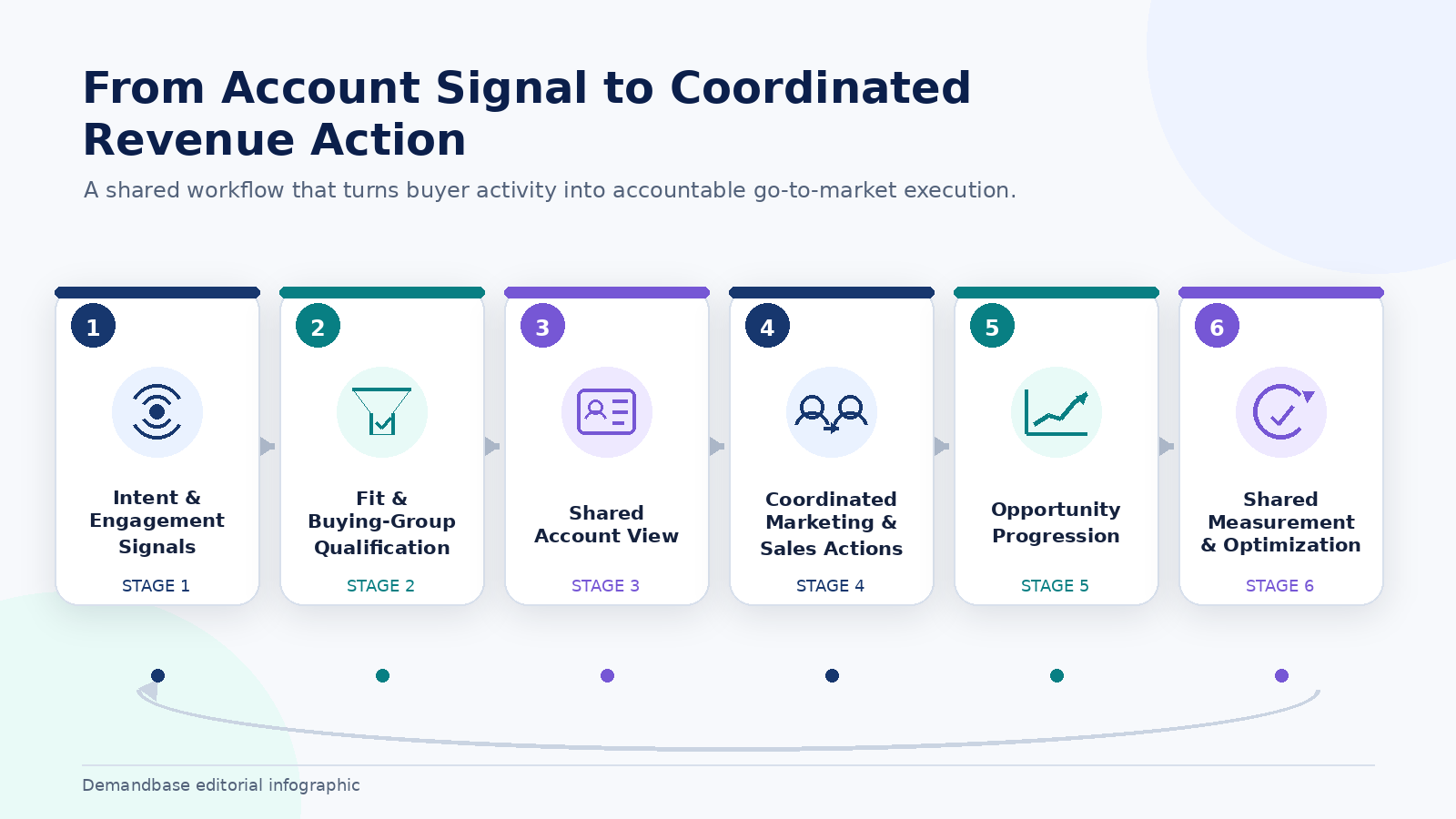
Sales and marketing alignment example: an in-market target account
Consider a high-fit target account that begins researching a priority topic, visits several product and comparison pages, and shows engagement from multiple people.
Shared trigger:
The account reaches the agreed combination of fit, intent, engagement, and buying-group activity required for coordinated action.
Marketing action:
Marketing moves the account into the appropriate play, adjusts advertising and website experiences, provides role-specific content, and identifies gaps in the buying group.
Sales action:
The assigned seller receives the account context, active topics, known buying-group members, recent engagement, recommended message, and next-best action. The seller reviews the account and begins outreach within the SLA.
Shared account progression:
Marketing continues to engage unresponsive and missing buying-group members while sales develops the active relationships. Both teams update the same account stage and use the same evidence to determine whether the account is qualified, recycled, or advanced to an opportunity.
Shared measurement:
The teams measure response time, buying-group coverage, engagement, meeting creation, opportunity conversion, stage progression, and revenue. They review which signals and actions influenced the outcome, then update the play.
This is alignment in practice: not a single handoff, but coordinated work around one account, one buying group, one set of signals, and one revenue outcome.
How Demandbase supports sales and marketing alignment
Demandbase gives B2B revenue teams a shared account, buying-group, and signal foundation for coordinated go-to-market action.
Teams use Demandbase to:
- Unify account context: Combine account, contact, buying-group, intent, engagement, and opportunity information.
- Prioritize the right accounts and buyers: Use fit, readiness, and buyer activity to focus resources.
- Identify buying-group gaps: See which roles are active, known, missing, or disengaged.
- Coordinate next actions: Route signals, automate workflows, and run integrated sales and marketing plays.
- Personalize engagement: Align advertising, web experiences, content, and seller outreach to account and buyer context.
- Measure shared outcomes: Connect account engagement and team activity to pipeline progression and revenue.
Related → Use the Align or Die guide to operationalize sales and marketing alignment
Sales and marketing alignment FAQ
What is sales and marketing alignment?
Sales and marketing alignment is a shared operating model that connects revenue goals, target accounts, buying groups, journey stages, data, workflows, messaging, and measurement. Each team keeps its distinct role, but both operate from the same account context and coordinate actions around shared pipeline and revenue outcomes.
Why is sales and marketing alignment important?
Alignment helps B2B teams focus resources on the right accounts, engage more of the buying group, respond faster to meaningful demand, deliver consistent messages, improve stage conversion, and diagnose pipeline problems using shared data. It also gives buyers a more coherent experience across marketing and sales interactions.
How do you align sales and marketing?
Build one revenue model, agree on the ICP and target accounts, map buying groups, define shared journey stages, establish action SLAs, create a common account view, coordinate messages and plays, and run weekly, monthly, and quarterly operating cadences. Assign an owner and measurable output to every step.
What metrics should sales and marketing share?
Sales and marketing should share target-account coverage, buying-group coverage, engaged-to-qualified conversion, sales action rate, response time, qualified-account-to-opportunity conversion, stage conversion, pipeline velocity, win rate, and revenue. Segment the metrics by tier, market, use case, and play.
What is a sales and marketing SLA?
A sales and marketing SLA is a documented agreement that defines the trigger, qualification criteria, owner, response time, required action, feedback, and recycling rule for an account or buyer event. It creates accountability and makes handoffs and coordinated actions measurable.
How does account-based marketing improve sales and marketing alignment?
Account-based marketing gives both teams a common unit of focus: the target account and its buying group. Marketing and sales can agree on account priority, combine engagement and relationship context, coordinate role-specific actions, and measure progression from account engagement through opportunity and revenue.
What tools help align sales and marketing?
Useful tools include CRM, marketing automation, account and buying-group intelligence, intent data, orchestration, analytics, sales enablement, data management, and integrations. The stack must create one account view, trigger accountable actions, and connect activity to pipeline outcomes.
How often should sales and marketing meet?
Run a weekly account action standup, a monthly performance review, and a quarterly strategy review. Share status data before each meeting and use meeting time to make decisions, resolve exceptions, assign coordinated actions, and update the operating model.
Turn alignment into coordinated action
Sales and marketing alignment becomes durable when both teams share the same account context, buying-group view, operating rules, and measures of success. Start with one revenue model, one target-account system, and one account journey. Then connect signals to clear actions and improve the system using shared performance data.
Book a meeting to see how Demandbase can help your sales and marketing teams prioritize the right accounts, coordinate buyer engagement, and turn shared pipeline goals into action.
Related content


We have updated our Privacy Notice. Please click here for details.